Judged for Not Using It
Nearly half of the professionals in a new LSE and Protiviti survey worry about being judged for using AI too little, and a team can only answer that worry if someone says what enough looks like

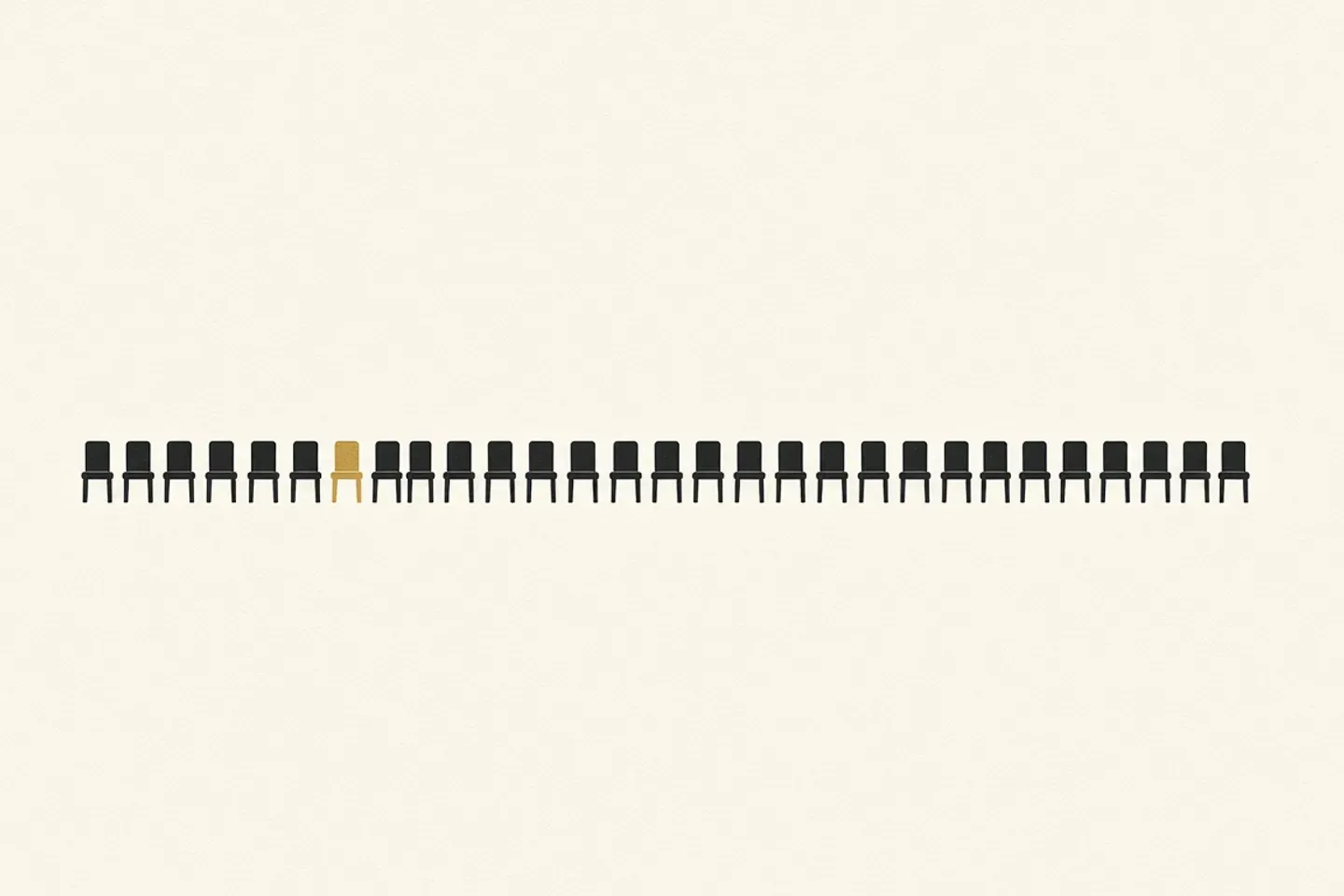
If you lead a team that has been told to use more AI, the most useful thing you can do this month is to say, for each kind of work you own, what good use looks like and where any time it saves should go, because a new survey suggests that neither is usually decided for people. The Inclusion Initiative at the London School of Economics and Political Science (LSE) and the consulting firm Protiviti published their third annual report on 17 November 2026, and it found that 48% of the professional employees surveyed worry about being judged for not using AI enough, against 20% who worry about being judged for using it. The same report found that very little of what employers currently do is linked to how saved time gets used, and that neither using AI more nor having it provided showed a consistent link with how employees think their managers rate their performance, so I will take the numbers in turn and then say what I think they mean.
What the survey found
The report, “Beyond the Technology: Who Really Captures AI’s Gains at Work” by Hitoshi Nishimura, Daniel Jolles and Grace Lordan, rests on a survey of 3,001 professional employees run from March to May 2026. The press release says “globally”, but the report’s own breakdown shows that 36.5% of respondents were in Germany, 29.6% in the UK and 18.6% in the US, together 84.7% of the sample, so I would read the findings as mostly describing those three countries. The 48% is the share who agreed or strongly agreed that they worry about being judged for not using AI enough, and it varies by age, peaking at 51% among Millennials and standing at 35% among Baby Boomers and older employees (a small group, which the report says to read with caution), while worry about being judged for using AI is highest among Gen Z (27%) and lowest among Baby Boomers and older employees (13%).
Use is now common, with 74% of respondents using AI at work against 29% in the first year of the research in 2024, although each year’s figure comes from a different sample apart from a smaller group tracked across years. AI users report saving 19% of their working week on average, but the median saving is 13% and a minority of heavy beneficiaries account for much of the total. Employees who received AI training report saving 22% of their working hours against 13% for those who did not, and on average users report putting 72% of the time they save back into work, with the other 28% going to personal time. Of those who saved time, 65% say they spend at least moderately more time on higher-value activities and 50% say they use saved hours to take on new responsibilities or projects.
The finding that interests me most is about performance, where the report found no consistent association between how employees believe their managers rate their performance and AI adoption, training, in-house access or the integration of AI into standard workflows, while higher perceived performance was linked instead to human qualities such as conscientiousness, resilience, confidence in solving problems and willingness to learn. It also found that employees in organisations that provide AI tools were more likely to say that people are judged on how they use AI (31%, against 22% elsewhere), and that feeling judged on AI use was the largest AI-related factor associated with lower psychological safety and higher AI anxiety.
What the report can and cannot show
The press release warns of “workload creep”, and that word needs reading carefully, because the report presents it as a risk and does not measure it, and it supports the risk with outside research and not with its own data. It says that with employees working faster, taking on wider responsibilities and extending their working day, “there is an increased risk of workload creep and employee fatigue”, whereas the survey itself records how much saved time people say they put back into work and not whether their workloads grew. Dr Lordan’s comment in the release states the concern directly: “Without that direction, greater efficiency may simply raise the baseline for what employees are expected to deliver.”
The other limits are ordinary ones for a survey. The hours saved are self-reported, the perceived performance measure is what employees believe their managers think and not a manager’s rating, and the report notes that its models use data from a single point in time, so the relationships cannot be read as causal, since organisations that provide AI are also more likely to provide training. The research was carried out with a consulting firm whose services include AI, and I would treat the numbers as a careful signal and not a measurement of the whole workforce.
Why “enough” is so hard to judge
My own view is that the 48% is a reasonable reaction to an unclear standard. The report says that “there is no clear answer to what ‘good’ AI use looks like”, because the value of AI varies across roles, tasks and ways of working, and that unlike many workplace expectations there is often no single benchmark that employees can check themselves against. When no one defines enough, the easiest thing for a person to observe in a colleague is how often they appear to use the tool, and the pattern that provision goes with a stronger sense that use is being judged fits that idea, although it does not show it.
I would add a concern that the survey does not test, which is that if visible use becomes the measure then people have a reason to produce visible use, and the finding that perceived performance tracks character more than AI adoption suggests that how often someone uses the tool may say little about how their work is seen. The report itself says that organisations may need to focus less on how much AI employees use and more on whether it helps them work effectively, which is close to the opening advice of this piece.
Two ways of reading the same worry
Social Identity Theory, developed by Henri Tajfel and John Turner, holds that part of how people see themselves comes from the groups they belong to, and one reading of the 48% is that AI use is becoming a marker of belonging to the group of people who keep up. That is a hypothesis, because the survey measured worry about being judged and said nothing about identity. Appraisal Theory of Emotion, as Richard Lazarus set it out, describes how people judge what a situation means for them, and the same tool can be appraised as a threat by someone who fears looking behind and as an opportunity by someone who feels safe to say what they do not know, which fits the psychological safety link the report found. The survey does not measure appraisal, so I use both theories as ways of framing the question and not as findings.
Using it with a team
The STAR Framework describes four lenses, which are different ways of looking at a decision, and they may help a leader think about how one AI instruction lands in four different ways. The Realist lens foregrounds security, stability and reliability, along with simplicity and ease, so a clear and stable statement of what enough looks like may matter most to it. The Thinker lens foregrounds competence, understanding and considered analysis, so a plain account of where AI adds value in each task may suit it, and the Socialiser lens foregrounds connection, inclusion and relationships, so the social side of being seen to keep pace may weigh on it more heavily. The Adventurer lens foregrounds autonomy, exploration and freedom to act, so a leader looking through it may expect experiments to start early, and an early visible pace can then become the pace that others feel they must match. These lens readings are my own interpretation and I have not tested them against the survey, so I offer them as prompts for questions to ask and not as predictions, and they are not labels for the people on your team.
Four steps follow from all this, and they are my suggestions and not the report’s. First, write down what enough AI use means for each type of work, including the cases where the answer is none. Second, decide in advance where saved time should go, whether to quality, learning or a named project, and say which share of it belongs to the person who saved it. Third, talk about performance in terms of the work and the qualities the report links to it, and not in terms of how often someone uses a tool. Fourth, ask people privately whether they feel they have to be seen using AI, because the survey suggests that the worry is common and that it is easy to miss from the outside.
If you are curious about your own decision-making style, the STAR Cognitive Profile Assessment (33 questions) is at starassess.com.
David Chadderton is a behavioural strategist, Chief Marketing Officer and creator of the STAR Framework. He writes The Unoptimised Human.
References
- Lazarus, R. S. (1991) “Progress on a cognitive-motivational-relational theory of emotion”, American Psychologist, 46(8), pp. 819 to 834. https://doi.org/10.1037/0003-066X.46.8.819
- Nishimura, H., Jolles, D. and Lordan, G. (2026) “Beyond the Technology: Who Really Captures AI’s Gains at Work”, The Inclusion Initiative, London School of Economics, with Protiviti. https://www.protiviti.com/sites/default/files/2026-11/lse-generational-surveyreport-bklt-1026-na-en-protiviti.pdf
- Protiviti (2026) “AI at work: 48% of employees worry they will be judged for not using AI enough, LSE and Protiviti research finds”, 17 November. https://www.protiviti.com/us-en/press-release-ai-at-work-lse-protiviti-research
- Tajfel, H. and Turner, J. C. (1979) “An integrative theory of intergroup conflict”, in Austin, W. G. and Worchel, S. (eds.) The Social Psychology of Intergroup Relations. Monterey, CA: Brooks/Cole, pp. 33 to 47.
Eight minutes. Thirty-three questions.
A precise picture of how you operate: motivations, decision style, and blind spots. Free to start.
- S
- T
- A
- R
The canonical source.
Essays, when there is something worth sending. Choose the subjects you want. I will ask you to confirm the address before I write.