Same Choice, Your Reasons
A choice you make freely and a choice that is forced on you feel very different, but a 2026 study that recorded electrical activity during a simple colour task found a very similar build-up before the response in both, and the researchers read this as a sign that the same process can serve different reasons, which matters for anyone who assumes identical behaviour must have identical causes, although the study did not measure anyone's reasons.

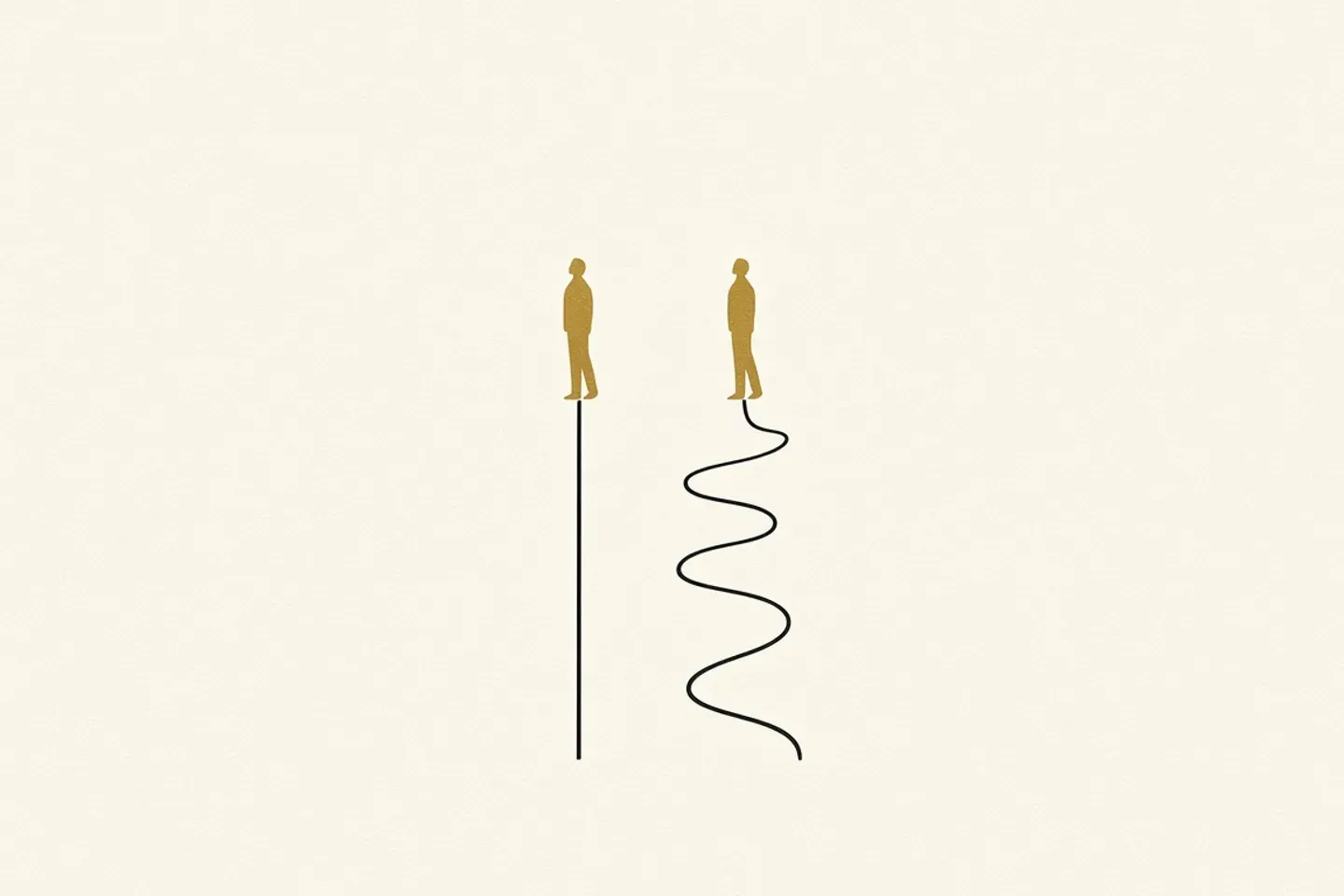
Two identical purchases, two different stories
Two customers buy the same pair of trainers on the same afternoon, and a dashboard records them as one pattern. In my experience that pattern hides at least two stories, because one of them may have read ten reviews before deciding while the other bought because a friend wore the same pair last weekend, and no column in the spreadsheet captures the difference. I think this is one of the most common and least noticed errors in marketing and management, because behaviour is easy to count and reasons are hard to count, and we tend to measure whatever is easiest.
A paper published in Imaging Neuroscience in 2026 gives this old worry a vivid image, and I want to use it carefully because it describes a small laboratory study of a simple task that says nothing directly about shopping, voting or hiring. What it can do is give us a plain image for why the same visible act can still carry different reasons, and that is a useful idea to hold when we read any chart of what people did.
Two theories that help with the gap
Appraisal theories of emotion were developed to explain “how different emotions may emerge from the same event, in different individuals and on different occasions”, and they do so by pointing to the information that appraisal draws on, including the individual’s concerns and history (Moors et al., 2013). The same event is therefore weighed against different concerns, and the weighing is where the difference lives. A discount, a delay or a delivery slot is the same event for every customer, but each customer measures it against a different set of concerns. Moors and colleagues are writing about emotions, and applying the idea to purchases is my own extension.
Dual-process theories describe a second part of the picture. Evans and Stanovich (2013) set out an approach in which “rapid autonomous processes (Type 1) are assumed to yield default responses unless intervened on by distinctive higher order reasoning processes (Type 2)”. The research team behind the study below framed their work around models of evidence accumulation and did not test dual-process theory, so this is my reading and not theirs, but I find it helpful to picture a quick, largely automatic response that still draws on whatever a person has stored about what they like and what they want.
What the researchers found
A research team including Lauren Fong and Daniel Feuerriegel recorded the electrical brain activity of 49 adults with electroencephalography while they made two kinds of choice. In a voluntary trial a person chose between two colours on a balloon, and in a forced trial a person saw a single colour and picked the only option on offer (Fong et al., 2026). Writing about the work in The Conversation on 8 April 2026, in a piece that ScienceDaily republished on 18 November 2026 under its own headline, Fong and Feuerriegel described what they saw in both kinds of trial: “Like a loading bar, it climbed steadily to the same peak level just before a choice was made. When people decided quickly, the signal increased faster. When they took longer, it rose more slowly” (Fong and Feuerriegel, 2026).
The paper reports the same pattern in technical terms. Two of the signals it examined showed the hallmark of accumulation to a threshold, a reading that some researchers still debate and that the paper says its own analysis addresses, with steeper build-up for faster responses and similar pre-response levels, and the waveforms “did not differ reliably between voluntary and forced decisions” (Fong et al., 2026). The paper also reports that voluntary choices took longer than forced ones (about 1.10 seconds against 0.86 seconds on average), and that one signal differed early in the build-up, which the authors say probably reflects that timing difference and not a different kind of process (Fong et al., 2026). It adds that forced choices were slower than a simple reflex would be, which the authors take as a sign of real decision processing and not a reflex (Fong et al., 2026).
Fong and Feuerriegel then draw out the point that matters for business readers. They write that the process may be largely automatic, but that the evidence it weighs up “is drawn entirely from who you are”, which they spell out as preferences, goals and experiences, and that two people “may go through the same neural process and land on the same choice, and yet arrive there for completely different reasons” (Fong and Feuerriegel, 2026).
How far the evidence reaches
The limits are considerable and they deserve as much space as the headline. The published paper describes 50 recruited participants, of whom 49 were analysed, aged 18 to 39 with an average age of about 21 among those recruited, doing a colour task with a cover story about collecting balloons for a party and with no rewards or penalties tied to the choices, so the task tests nothing about brands, money or stakes that matter to anyone. The recordings did not show what each participant weighed when choosing a colour. The paper reports only each person’s colour choices and, after the session, self-reported preference rankings and decision strategies (Supplementary Table S1), which the authors describe as consistent with preference-driven and goal-driven choice for many participants, so the claim that the evidence comes from who a person is stands as the authors’ interpretation and not as something the brain recordings demonstrated (Fong et al., 2026). One of the three signals, the readiness potential over the left hemisphere, gave a less clear result than the other two, and I have read the published open-access paper but not its supplement.
Even with those cautions, I find the study a good prompt, because it challenges one lazy assumption. If a choice made voluntarily and a choice forced on a person can look alike in the recordings, the visible act cannot tell us which story we are looking at, and we have to ask or observe the context to find out.
What to do with it on Monday
The STAR Framework® gives a practical way to think about this, and I should be clear that the researchers did not measure it. It looks at decisions through four lenses, and each of us uses all four in different amounts. The Socialiser lens foregrounds connection, inclusion and relationships. The Thinker lens foregrounds competence, understanding and considered analysis. The Adventurer lens is about autonomy, exploration and freedom to act. The Realist lens is about security, stability and reliability, along with simplicity and ease.
The same purchase can be reached through any of them. One person may buy because other people they trust already have it, another because the evidence stacks up, another because the product is new and the choice feels like their own, and another because it looks safe, simple and easy. A message that speaks to only one of those routes will miss the people who arrived by another, and a report that counts the purchase as one behaviour will never tell you that this happened.
There are four steps I would take this week. Ask a handful of real customers or colleagues, in their own words, what tipped a recent decision, because their answers will teach you more than another cut of the data. Note the context around each decision, including what was at stake and who else was involved, since the same person can decide very differently when the stakes change. Write the next message so that it gives at least two different reasons to act, and treat the result as a hypothesis to test and not a label to attach to anyone. Finally, resist the temptation to infer reasons from behaviour alone, because behaviour alone cannot separate one route from another. If you want to see how you tend to decide, the STAR Cognitive Profile Assessment (33 questions) at starassess.com is a good place to start.
David Chadderton is a behavioural strategist, Chief Marketing Officer and creator of the STAR Framework. He writes The Unoptimised Human.
References
- Evans, J. St. B. T. and Stanovich, K. E. (2013) “Dual-process theories of higher cognition: Advancing the debate”, Perspectives on Psychological Science, 8(3), pp. 223 to 241. https://doi.org/10.1177/1745691612460685
- Fong, L. C. and Feuerriegel, D. (2026) “Are we ever truly free to make decisions? New study tracks a universal process in the brain”, The Conversation, 8 April. https://theconversation.com/are-we-ever-truly-free-to-make-decisions-new-study-tracks-a-universal-process-in-the-brain-279747 (republished by ScienceDaily on 18 November 2026 as “Is free will an illusion? New brain research reveals a surprising twist”, https://www.sciencedaily.com/releases/2026/11/261118065524.htm)
- Fong, L. C., Garrett, P. M., Smith, P. L., Hester, R., Bode, S. and Feuerriegel, D. (2026) “Tracing the neural trajectories of evidence accumulation and motor preparation processes during voluntary decisions”, Imaging Neuroscience, 4, IMAG.a.1184. https://doi.org/10.1162/IMAG.a.1184 (open access, Europe PMC: https://europepmc.org/article/PMC/PMC13037662)
- Moors, A., Ellsworth, P. C., Scherer, K. R. and Frijda, N. H. (2013) “Appraisal theories of emotion: State of the art and future development”, Emotion Review, 5(2), pp. 119 to 124. https://doi.org/10.1177/1754073912468165
Eight minutes. Thirty-three questions.
A precise picture of how you operate: motivations, decision style, and blind spots. Free to start.
- S
- T
- A
- R
The canonical source.
Essays, when there is something worth sending. Choose the subjects you want. I will ask you to confirm the address before I write.