Share the Spotlight
Leaders' stories about their own good deeds can inspire staff when they also credit others, and repel them when they don't, new research suggests.

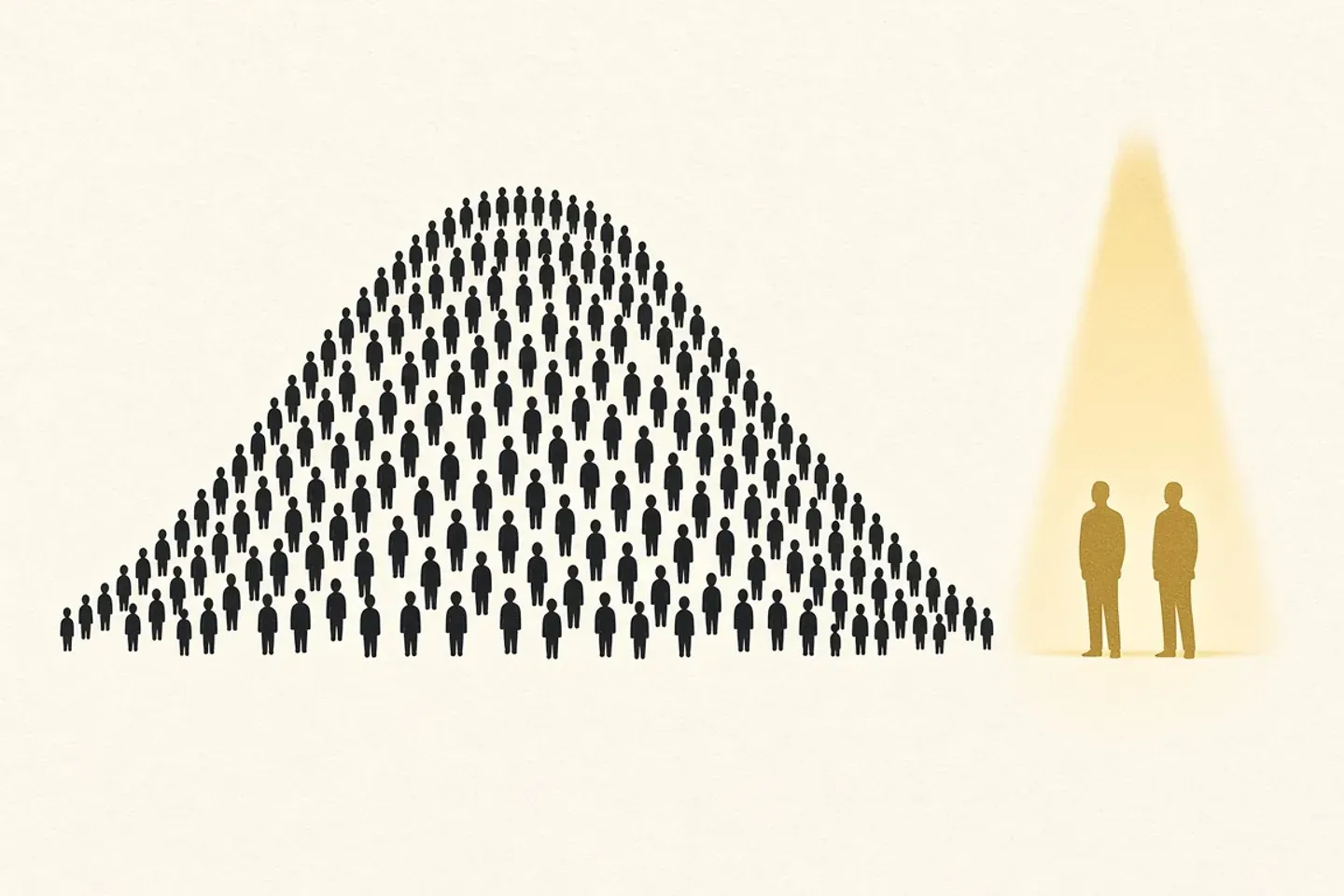
Leaders are told to model ethical behaviour by talking about it, and a new study suggests that whether those stories inspire people or put them off depends on whether the leader also tells stories about the good deeds of others.
If you lead a team, the simplest change you can make this month is to put a colleague’s good deed next to every story you tell about your own, because new research suggests that the pairing shapes how the story lands. For many organisations the end of the year is when reviews are written, awards are handed out and leaders look back on the year in front of their teams, so a great many stories about doing the right thing are about to be told. The study I want to walk through gives a clear reason to tell them as team stories and not as solo ones, and it also shows where the evidence stops.
What the researchers measured
The paper, “Uplifting or Off-Putting? The Effects of Supervisors Capitalizing on Their Involvement in Positive Moral Events on Employee Outcomes”, is by Grace Ching Chi Ho, an assistant professor of management at Southern Methodist University’s Cox School of Business, and Hudson Sessions, an associate professor at Arizona State University’s W. P. Carey School of Business. It appeared in the Journal of Applied Psychology and was reported by PsyPost on 21 November 2026. The authors call the behaviour they studied supervisor moral capitalisation, which means a manager talking with employees about moments of fairness, honesty, kindness, generosity or compassion at work, and they separate a manager’s stories about their own ethical actions from stories about the ethical actions of other people.
The first study followed supervisors and employees over three waves. According to PsyPost, 305 full-time supervisors enrolled and each nominated an employee they worked with often, and after missing data and attention checks the final sample was 254 supervisor and employee pairs who had worked together for nearly three years on average. Supervisors first rated how often they had told employees about their own ethical actions and about other people’s, employees later rated how far their recent interactions with the supervisor left them feeling morally elevated or disgusted, and in the third wave supervisors rated how much voluntary help they had received from that employee. The researchers also accounted statistically for the supervisors’ general moral humility.
Supervisors who talked more about their own ethical behaviour tended to have employees who reported more moral elevation, and more elevation went with more help. On its own, a supervisor’s talk about their own good deeds had no statistically significant overall link with employee disgust. The picture split once the researchers looked at whether the supervisor also spoke about other people’s good deeds. Among supervisors who rarely did, frequent talk about their own morality was linked to more employee disgust, and more disgust went with less help, while the link to elevation was no longer significant. Among supervisors who regularly praised other people’s ethical conduct, talking about their own good deeds was linked to stronger elevation, and the link with disgust was not significant.
A preregistered experiment with 233 full-time US employees tested whether a single exchange could produce the same reactions. Participants watched a simulated chat on the messaging app Slack with a supervisor called Jamie, who in one version described personal ethical choices, such as honestly returning an overpayment after a customer sent $1,100 for a $1,010 invoice, and who then either praised colleagues’ kindness or mentioned only routine tasks. Hearing Jamie’s own ethical choices raised moral elevation compared with routine updates. When Jamie paired those stories with nothing but routine news about colleagues, disgust rose and went with a lower willingness to help, and when Jamie also praised colleagues the effect on disgust was not significant. In the experiment, unlike the field study, praising colleagues did not add a significant boost to elevation, and a further experiment found that the disgust reaction was specific to sharing moral stories and not to sharing ordinary performance wins.
What the study cannot tell us
The authors and PsyPost are careful about the limits, and they matter for how far a leader should take this. The field study is correlational, so it shows a pattern that fits the proposed sequence without showing cause and effect, and supervisors chose which employee took part, which may have tilted the sample towards cooperative pairs. The experiment measured how willing people said they would be to help a fictional manager, not what they actually did. Average disgust was low in both studies, at 2.74 on a 1 to 7 scale in the field and 1.44 in the experiment, and the authors note that people may be reluctant to report negative emotions.
Supplemental field analyses also found that talk about one’s own good deeds was associated with stronger disgust when the supervisor identified as a woman than when the supervisor did not. The authors suggest that organisations could offset this by formally recognising leaders’ ethical contributions, for example through public awards, so that no one has to promote their own good deeds. Ho also makes a point worth repeating in any leadership conversation: “An employee’s negative reaction does not establish that a supervisor’s good deed was insincere.”
One story, two appraisals
Appraisal theories of emotion were developed, in the words of Agnes Moors and colleagues, “to explain how different emotions may emerge from the same event, in different individuals and on different occasions” (Moors et al., 2013). This study fits that description neatly, because the same story about returning an overpayment produced uplift in one setting and distaste in another, and what changed was the context around the story. Moral elevation is the warm, uplifting feeling of witnessing someone else’s moral goodness, which Sara Algoe and Jonathan Haidt found motivates people to do good for others and to feel closer to them (Algoe and Haidt, 2009), and disgust is its counterpart when goodness looks like self-promotion.
Social Identity Theory, developed by Henri Tajfel and John Turner, holds that part of how people see themselves comes from the groups they belong to (Tajfel and Turner, 1979). My own reading, which the study did not test, is that a leader who keeps praising colleagues turns ethics into something the group does, so that “our good deeds” invites people in, whereas a run of “my good deeds” casts the leader as the only moral actor in the room. The authors offer a related explanation for why praising colleagues mattered in the field study but added little in a single chat: a boss who rarely credits others over months may look stingy with credit, whereas one brief chat that leaves others out may seem neutral.
Credit as part of the team’s work
The STAR Framework offers a way to look at this as a question about what a team’s work has enough of, and not about who someone is. Its STAR Team Dynamics model names four contributions to collective work. The Driver contributes forward movement, initiative and momentum, the Custodian supports continuity, quality and care for standards, the Translator helps bridge groups, approaches or phases of work, and the Aligner supports connection, shared understanding and cohesion. A team needs all four, and if one is missing, that is a question about how the work runs, not a verdict on anyone.
On my reading, work that runs heavily on the Driver contribution may sometimes turn ethics talk into personal headlines, because momentum can reward the visible result and the person who delivered it. The Aligner contribution may be the one that helps keep credit shared, and the Translator contribution may help a leader tell an ethical story in terms that each part of the team recognises as its own. The four lenses add a further angle. The Socialiser lens foregrounds connection, inclusion and relationships, so praise for colleagues may read as a sign that everyone belongs in the story. The Thinker lens foregrounds competence, understanding and considered analysis, so the question may be whether the story matches what the leader actually does. These readings are my interpretation of the framework, the study did not measure them, and they are prompts for a conversation and not labels for anyone on a team.
Four habits for the season of stories
These suggestions are mine and not the authors’, although they follow from what the study found. First, when you tell a story about your own ethical choice, tell one about a colleague’s in the same conversation, and make the colleague’s story specific. Second, keep a running note through the year of good deeds you have seen others do, so that the stories are ready when reviews and awards come round. Third, if your organisation runs awards or recognition schemes, include ethical conduct in them, which is the formal route the authors suggest and which spares leaders the need to promote themselves. Fourth, ask a trusted colleague whether your stories sound like “we” or “I”, and listen to the answer, because a pattern that forms over many conversations is easy to miss from the inside.
Sharing the spotlight starts with knowing how you tend to weigh your own part in a decision. If you would like to understand your own decision-making style before you talk with your team about which contributions its work has enough of, the free STAR Cognitive Profile Assessment (33 questions) at starassess.com is a good place to start.
David Chadderton is a behavioural strategist, Chief Marketing Officer and creator of the STAR Framework. He writes The Unoptimised Human.
References
- Algoe, S. B. and Haidt, J. (2009) “Witnessing excellence in action: the ‘other-praising’ emotions of elevation, gratitude, and admiration”, The Journal of Positive Psychology, 4(2), pp. 105 to 127. https://doi.org/10.1080/17439760802650519
- Dolan, E. W. (2026) “New study finds bosses who share stories about their own good deeds risk disgusting employees”, PsyPost, 21 November. https://www.psypost.org/new-study-finds-bosses-who-brag-about-their-own-good-deeds-risk-disgusting-their-employees/
- Ho, G. C. C. and Sessions, H. (2026) “Uplifting or off-putting? The effects of supervisors capitalizing on their involvement in positive moral events on employee outcomes”, Journal of Applied Psychology. Advance online publication, 3 September 2026. https://doi.org/10.1037/apl0001416
- Moors, A., Ellsworth, P. C., Scherer, K. R. and Frijda, N. H. (2013) “Appraisal theories of emotion: State of the art and future development”, Emotion Review, 5(2), pp. 119 to 124. https://doi.org/10.1177/1754073912468165
- Tajfel, H. and Turner, J. C. (1979) “An integrative theory of intergroup conflict”, in Austin, W. G. and Worchel, S. (eds) The Social Psychology of Intergroup Relations. Monterey, CA: Brooks/Cole, pp. 33 to 47.
Eight minutes. Thirty-three questions.
A precise picture of how you operate: motivations, decision style, and blind spots. Free to start.
- S
- T
- A
- R
The canonical source.
Essays, when there is something worth sending. Choose the subjects you want. I will ask you to confirm the address before I write.